📜 Ishmael’s Absence in the Quranic Triad of Abraham, Isaac, and Jacob

❓Why Ishmael Is Not Named Alongside Isaac and Jacob in the Qur’an

Dedication, Sacrifice, and the Logic of Divine Ownership

Introduction

One of the most striking patterns in the Qur’an is the repeated pairing of Abraham with Isaac and Jacob, while Ishmael is usually not included in that triad. This has often been misunderstood as a sign of Ishmael’s lesser status. Yet, when the Qur’anic narrative is read holistically, the opposite emerges.✨

The absence of Ishmael from the Abraham–Isaac–Jacob triad does not reflect exclusion. Rather, it reflects a different mode of belonging—one that arises from Ishmael’s unique dedication to God from the earliest moments of his life.💫


Ishmael Was Given to God — Isaac Was Given to Abraham

In Islamic tradition, Abraham was commanded by God to leave Hagar and her infant son Ishmael in the barren valley of Mecca (Qur’an 14:37). This was not abandonment; it was consecration. Abraham was instructed to place Ishmael entirely in God’s custody, outside the normal structures of family, inheritance, and paternal protection.

From that moment onward, Ishmael no longer belonged to Abraham in the ordinary paternal sense. He belonged to God. 🕊️

This consecration reached its climax when Abraham later saw in a dream that he was commanded to sacrifice his “only son” (Qur’an 37:102). In Islamic understanding, this son was Ishmael, because Isaac had not yet been born at the time of that test. Abraham did not hesitate. He prepared to surrender Ishmael to God in the ultimate act of devotion. 🔥

Although God intervened and spared Ishmael, the offering had already been completed in meaning. Ishmael had been given away.

Spiritually, Ishmael was no longer Abraham’s possession.
He was God’s offering returned alive. 🌿


Why Isaac and Jacob Are Named Together with Abraham

This explains a crucial Qur’anic pattern.

When the Qur’an speaks of Abraham, Isaac, and Jacob, it is not merely listing sons. It is identifying the household lineage that remained with Abraham—the branch of his family that stayed under his direct guardianship. 🏠

Verses such as:

💎 Surah 11:71: “And his wife was standing, and she laughed. Then We gave her good tidings of Isaac and after Isaac, Jacob.”

💎 Surah 38:45: “And remember Our servants, Abraham, Isaac, and Jacob—those of strength and vision.”

💎 Surah 29:27: “And We gave to Abraham, Isaac and Jacob, and We placed in his descendants prophethood and scripture.”

💎 Surah 19:49: “So when he had left them and those they worshipped besides Allah, We gave him Isaac and Jacob, and each of them We made a prophet.”

💎 Surah 12:38: “And I have followed the religion of my fathers, Abraham, Isaac, and Jacob…”

💎 Surah 6:84: “And We gave to him Isaac and Jacob; all [of them] We guided…”

…are describing the Abrahamic household line, not the totality of Abraham’s fatherhood.

Ishmael is absent from this triad not because he was excluded, but because he had already been given away to God. 🌌


Ishmael: The Son Who Belonged to God

Ishmael occupies a different theological category.

He is:

• The son entrusted to God in the desert 🏜️
• The son offered in sacrifice 🐏
• The son through whom the final Messenger would come 🕋

He does not appear in the Abraham–Isaac–Jacob triad because he was no longer Abraham’s to enumerate.

He was God’s. ✨

In this sense, Ishmael’s omission from that lineage list is not loss—it is elevation. ⬆️


Two Covenants, One Faith

The Qur’an presents two unfolding streams of divine purpose:

• Through Isaac and Jacob came the Sinai covenant—a national and legal mission for Israel. 📜
• Through Ishmael came the Abrahamic covenant fulfilled—the universal message of monotheism through Muhammad ﷺ. 🌍

Isaac represents the reward of Abraham’s faith.
Ishmael represents the price Abraham paid in placing divine will above paternal possession. ⚖️

Isaac was what Abraham received; Ishmael was what Abraham gave.✨


Conclusion

The Qur’an’s repeated pairing of Abraham with Isaac and Jacob is not an exclusion of Ishmael but a recognition of two distinct forms of covenantal belonging. Isaac and Jacob represent continuity within Abraham’s family. Ishmael represents Abraham’s ultimate surrender—a son dedicated so completely to God that he no longer belongs to Abraham at all. 🕌

Ishmael’s omission from the Abraham–Isaac–Jacob triad reflects not marginalization, but a distinct theological status rooted in his early dedication to God.🌟👐
🕌🕍 Islamic Eid al-Adha (feast of sacrifice) vs Jewish Passover

🌟 Some contend that the celebration of Eid al-Adha (feast of sacrifice) by all Muslims, in contrast to the Jewish observance of Passover, suggests that Muslims are linked to the Abrahamic covenant through Ishmael, while Jews are associated with the Sinai covenant. How does their argument go?

📖 The argument that Muslims are linked to the Abrahamic covenant through Ishmael, while Jews are associated with the Sinai covenant, is based on a few key points:

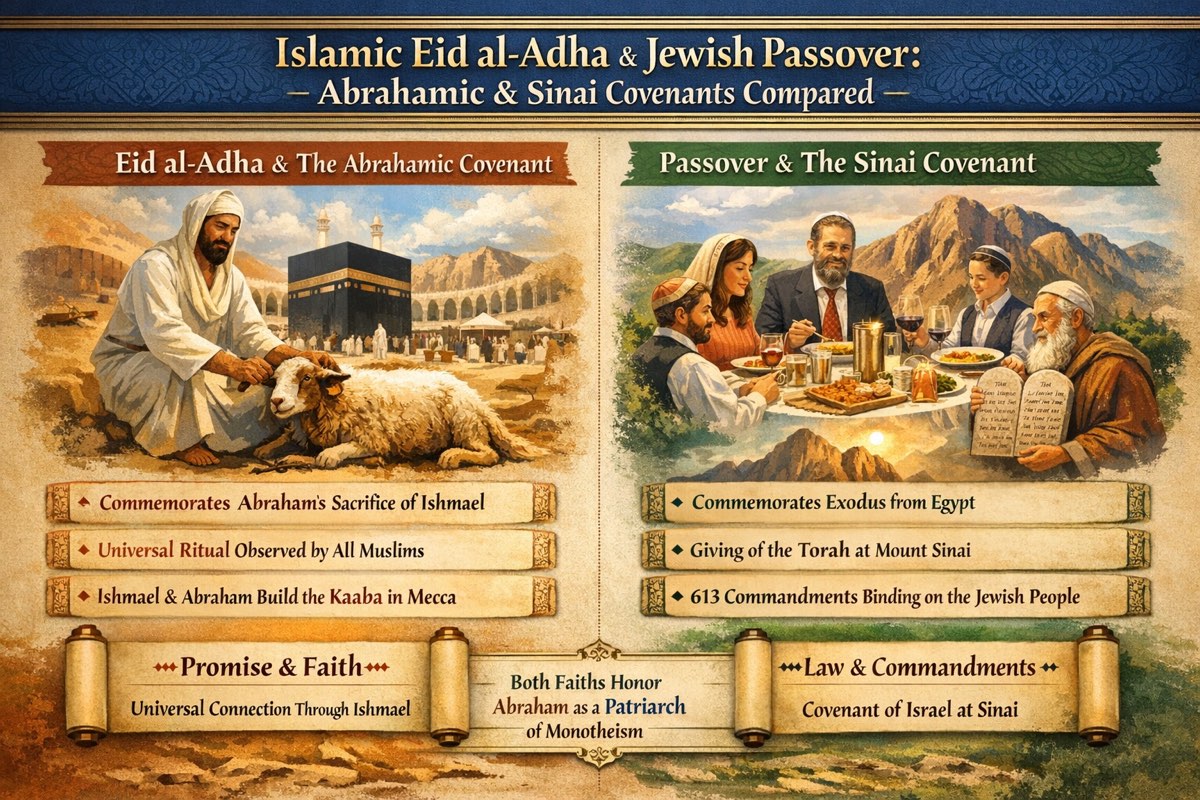
1. Eid al-Adha commemorates Abraham’s willingness to sacrifice his son, which Muslims believe was Ishmael rather than Isaac. This directly connects Muslims to Abraham and Ishmael. 🕋

2. All Muslims worldwide celebrate Eid al-Adha by sacrificing an animal, reminiscent of Abraham’s sacrifice. This universal observance is seen as linking all Muslims to the Abrahamic covenant. 🌍

3. The Quran portrays Ishmael as assisting Abraham in building the Kaaba (House of God) in Mecca, further cementing the connection between Muslims, Abraham and Ishmael. 🕊️

4. In contrast, Passover specifically commemorates the Exodus of the Israelites from Egypt under Moses’ leadership. This event is directly tied to the giving of the Torah and establishment of the Sinai covenant. 🕎

5. The Sinai covenant, with its 613 commandments, is seen as specifically binding on Jews rather than on all people. 📜

6. Some argue there is a distinction between the Abrahamic covenant characterized by promise, and the Sinai covenant characterized by law. ⚖️

7. While both trace ancestry to Abraham, Muslims see themselves as spiritual descendants of Ishmael, while Jews trace their lineage through Isaac and Jacob. 🌱

🔎 Therefore, this difference in religious observances implies that Muslims see themselves as heirs to the Abrahamic covenant through Ishmael, while Jews associate themselves more closely with the later Sinai covenant.

🤝 However, it’s important to note that both religions still consider Abraham a key patriarch and founder of monotheism.

🧠 This argument highlights some of the theological differences between Islam and Judaism regarding their relationship to Abraham and divine covenants, though both religions still revere Abraham as a major prophet and patriarch.

🌿 Circumcision in Pre-Islamic Arabia: An Abrahamic Legacy Beyond the Torah

🌍 Introduction

🧭 Interestingly, long before the rise of Islam, ancient Arabs in Mecca practiced circumcision—often performing the rite at the age of thirteen or fourteen. This raises an important historical and theological question: did this practice originate from Jewish law, which mandates circumcision on the eighth day after birth, or does it reflect an older Abrahamic tradition that predates the Torah itself?

🪶 A closer examination of chronology, ritual practice, and Abrahamic lineage strongly suggests that circumcision among the Arabs of Mecca was not borrowed from Judaism, but rather inherited as a primordial covenantal rite tracing back to Abraham himself.


📜 Circumcision Before the Torah

📖 The Torah’s commandment of circumcision on the eighth day (Genesis 17:12) is often assumed to be the original source of the practice. However, the biblical narrative itself indicates that circumcision predates the Mosaic Law. Abraham was circumcised as an adult, and his son Ishmael was circumcised at the age of thirteen (Genesis 17:24–25), long before the revelation of the Torah at Sinai.

🧠 This detail is crucial. It shows that circumcision originally functioned not as a legalistic ritual tied to a fixed infancy timeline, but as a sign of covenantal submission to God—performed at an age associated with moral awareness and personal accountability.


🕰️ The Age of Thirteen and the Abrahamic Pattern

📌 The fact that ancient Arabs circumcised their children around the age of thirteen or fourteen closely mirrors the age at which Ishmael was circumcised. This parallel is difficult to dismiss as coincidence. Rather, it points to a preserved Abrahamic memory, transmitted through generations of Ishmael’s descendants independently of Jewish law.

🔍 If Arab circumcision were derived directly from Judaism, we would expect conformity to the Torah’s eighth-day requirement. Instead, the persistence of circumcision at adolescence suggests continuity with Abraham’s first covenantal act—before the Torah, before Israel, and before Sinai.


🌐 Independent Transmission of Abrahamic Tradition

🧬 Abraham is recognized as a common ancestor of both Jews and Arabs, yet the two lineages developed distinct ritual expressions of shared Abrahamic practices. Judaism formalized circumcision within a legal framework tied to infancy, while the Ishmaelite tradition appears to have retained an older form of the rite—performed at the threshold of maturity.

🏺 This divergence supports the idea that ancient Arabian circumcision was not an imitation of Jewish custom, but a parallel inheritance rooted in a shared patriarchal past. The tradition survived in Arabia as part of a living Abrahamic legacy, even as other elements of Abrahamic monotheism became obscured over time.

���

☪️ Islam and the Restoration of Abrahamic Practice

🕌 Islam later re-affirmed circumcision as part of the fitrah—the natural disposition associated with Abrahamic monotheism—without fixing it to a specific age in the Qur’an. This flexibility reflects the original Abrahamic character of the practice: a sign of covenant and submission rather than a rigid legal requirement.

✨ In this sense, Islam did not introduce circumcision to Arabia, nor did it borrow it from Judaism. Instead, it restored and re-contextualized an ancient Abrahamic rite that had already existed among the Arabs of Mecca for centuries.


📚 Conclusion

🧾 The practice of circumcision among pre-Islamic Arabs is best understood not as a derivative of the Torah, but as a vestige of an older Abrahamic covenant that predates Jewish law. The age at which the rite was performed, its deep cultural entrenchment, and its alignment with Ishmael’s circumcision all point toward an independent transmission rooted in Abraham himself.

🌟 Thus, circumcision in ancient Mecca stands as historical testimony to a shared Abrahamic inheritance—one that existed before the Torah, endured outside Israel, and was ultimately reaffirmed through Islam as part of the universal legacy of Abraham.